Research

When institutions fall short, can AI help?

How can AI expand comfort, agency, and access to support when existing organizations or institutions do not adequately accommodate individual needs?

Conversational AI can offer individualized support — but not necessarily the way another person would, and it can introduce errors and bias of its own. My work asks when and how these systems can best be designed and used for people who may have few other places to turn. Healthcare, trauma, and neurodivergent work are three settings where that question is especially consequential.

Questions, contributions, methods, and status.

Adds theory, study designs, and future extensions.

The research program at a glance

Each line of work connects a setting where support falls short to the AI behaviors, mechanisms, and outcomes it examines. Select one to trace its path.

Research program map: how each line of work connects a setting to an unmet need, the AI behavior studied, mechanisms, methods, and outcomes.
Line of workSettingUnmet needAI behavior studiedMechanismMethodsOutcome
Healthcare encountersDissertationPatients at intakeForms and rushed interactions miss lived experienceMemory-based recall; validation; identity concordancePerceived warmth and competenceInterviews → factorial surveyPsychological comfort
Trauma disclosureDissertation · plannedPeople processing traumatic experiencesSupport unavailable or not soughtAlgorithmic witnessing; disclosure style and affordancesSocial-affective responses to traumaInterviews → experimentWell-being
Neurodivergent workDissertation · plannedNeurodivergent knowledge workersWorkplace support may not fit individual needsAI as a self-directed personal resourceJob demands and resources; regulatory styleInterviews → surveyTask engagement; reduced burnout
Healthcare privacyRelated streamPatient–provider interactionsPatients withhold or misrepresent health informationHealth information systems and disclosure contextsPrivacy calculus: probability vs. impactSurveysAccurate disclosure
Judgmental AIRelated streamPeople receiving AI evaluations of themselvesOpaque judgments of personal attributesEvaluative feedback on appearance (CNN artifact)Self-verification; expectation confirmation; reactanceExperiments with a built artifactTrust, satisfaction, self-perception

Dissertation

Meeting the moment with understanding, flexibility, insight, and assistance

The dissertation, Leveraging AI to support individual differences and experiences, distinguishes three sources of institutional mismatch. They differ in the malleability, centrality, and concealability of the associated stigma or disadvantage — and therefore in which conversational-agent affordances are likely to be most valuable.

Healthcare encounters
Contextual marginalization — disadvantage that arises from a role a person occupies, such as being a patient.
Trauma disclosure
Experiential marginalization — disadvantage that arises from events a person has lived through, such as sexual assault or other trauma.
Neurodivergent work
Constitutive marginalization — disadvantage associated with enduring characteristics, such as neurodivergence.

Co-chairs: Tabitha L. James and Anthony Vance · Pamplin College of Business, Virginia Tech

Healthcare encounters · Dissertation Paper 1

Patient-centered healthcare AI

Mixed-method study · Job-market paper, to be submitted fall 2026

Intake is a foundational point of contact in healthcare, yet forms, checklists, and rushed verbal interactions often fail to accommodate the complexity of patients’ lived experiences. That can lead to misrepresentation and missed opportunities for care, particularly for marginalized patients.

Research questionHow does the design of an AI intake assistant shape whether patients feel comfortable during intake?

What the study shows. Identity concordance and patient-centered communication influence patients’ perceptions of an AI intake assistant’s warmth and competence, which in turn shape psychological comfort — explaining why technically capable systems may still fail when patients do not feel seen, heard, or believed.

Theoretical lens
  • Stereotype content model (warmth and competence)
  • Patient-centered communication
  • Anthropomorphism and human–AI communication
Methods
  • 27 semi-structured interviews (about 1,420 recorded minutes)
  • Inductive coding (κ ≈ .81)
  • Factorial survey experiment with AI-mediated intake vignettes
Coauthors
Tabitha L. James, Anthony Vance, Paul B. Lowry

Theoretical grounding

IS research on conversational agents has largely examined how designed anthropomorphic cues — visual or verbal — affect trust, social presence, engagement, and intentions to use. Large-language-model agents exhibit many humanlike communication traits by default, blurring the line between scripted anthropomorphism and emergent humanlike interaction. This study asks how that naturally occurring communication shapes experience in a setting where nuance, sensitivity, and individual variation are central.

The stereotype content model holds that people judge others along two dimensions — warmth and competence. Here, those judgments are applied to an AI intake assistant, and they explain how patient-centered communication and identity concordance translate into psychological comfort.

From interviews to experiment

  1. Interviews. 27 semi-structured interviews (about 1,420 recorded minutes) with participants recruited for diverse healthcare experiences and health-condition complexity.
  2. Coding. Inductive coding with a co-developed framework (κ ≈ .81) yielded three themes, being heard, believed, and seen, plus two contextual themes: higher stakes for patients with complex health histories, and calibrated skepticism toward AI’s emotional attunement.
  3. Design principles. Each theme became a manipulable design element: memory-based recall, symptom and emotional validation, and identity concordance.
  4. Factorial survey. Participants evaluate AI-mediated intake vignettes that vary those elements; warmth, competence, and psychological comfort are analyzed with multilevel regression, with health-condition complexity as a moderator.
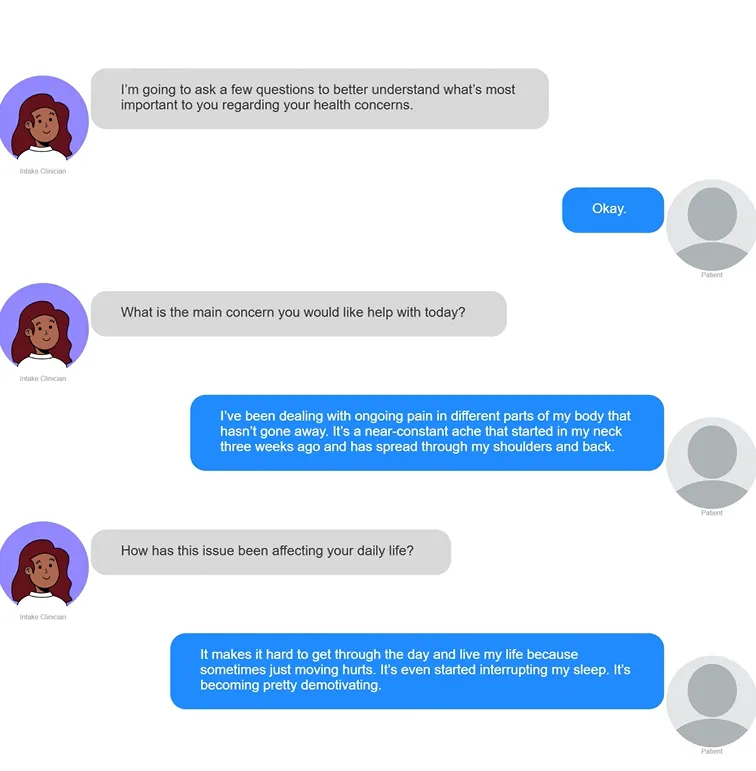
Mockup of an intake conversation. An illustrated intake assistant asks what matters most to the patient about their health concerns, what their main concern is, and how it affects daily life. The patient describes ongoing neck, shoulder, and back pain that is interrupting their sleep.
Study materials. A mockup of an AI intake-assistant conversation from the vignette design. It is a research stimulus, not a clinical tool, and does not provide medical advice.

Being heard → believed → seen → comfortable

The study’s argument as a sequence: each step pairs an assistant behavior with its theoretical interpretation.

  1. Step 1 of 4

    Being heard

    Design behavior
    Memory-based recall. The assistant recalls personal and health information the patient has already shared, within the conversation and across visits.
    Theoretical interpretation
    Interviewees described attentiveness, continuity of care, and being remembered as the foundation of feeling genuinely known by a provider.
  2. Step 2 of 4

    Being believed

    Design behavior
    Symptom and emotional validation. The assistant acknowledges that the patient’s symptoms and emotional responses make sense, rather than dismissing them.
    Theoretical interpretation
    Accounts of good and bad intake experiences centered on validation versus dismissal, paralleling clinical research showing that invalidation harms health, well-being, and help-seeking.
  3. Step 3 of 4

    Feeling seen

    Design behavior
    Identity concordance. The assistant’s presented identity, such as gender or race, matches aspects of the patient’s identity.
    Theoretical interpretation
    Interviewees described seeking identity-concordant providers for sensitive or gendered health concerns.
  4. Step 4 of 4

    Feeling comfortable

    Design behavior
    Perceived warmth and competence. Being heard, believed, and seen are modeled as shaping how warm (does it care about me?) and how competent (can it help me?) the assistant seems.
    Theoretical interpretation
    Stereotype content model: warmth and competence perceptions jointly mediate psychological comfort. Interviewees readily accepted AI competence but questioned its emotional attunement, suggesting warmth may matter more.

Trauma disclosure · Dissertation Paper 2

AI-mediated trauma disclosure

Qualitative study in design · To be submitted spring 2027

People who have experienced trauma may not have access to, or may not seek out, organizational and institutional support. Some are already turning to conversational AI — whether or not it is recommended.

Research questionWhen and why do people turn to conversational AI to witness a trauma disclosure, how do they use it, and what are the advantages and disadvantages of doing so?

What the study will examine. The planned experiment will examine which combinations of disclosure style and algorithmic affordance may enhance well-being for people with different social-affective responses to trauma.

Status. This study is in design. No findings are reported yet.

Theoretical lens
  • Socio-interpersonal model of post-traumatic stress disorder
  • Affordances theory
  • Self-disclosure
Planned methods
  • Qualitative study
  • Experiment on disclosure style and algorithmic affordances
Coauthors
Tabitha L. James, Anthony Vance

An algorithmic witness

The socio-interpersonal model of post-traumatic stress disorder emphasizes the social and interpersonal context of recovery, including disclosure and how others respond to it. When a person discloses to a conversational agent instead, the agent becomes a kind of algorithmic witness. It can offer individualized support, but not necessarily the support another person would — and it can introduce errors and bias of its own. The qualitative study will document when and why people turn to AI for this, how they use it, and the advantages and disadvantages they experience — informing an experiment on which combinations of disclosure style and algorithmic affordance may enhance well-being.

Neurodivergent work · Dissertation Paper 3

Neurodivergence, work, and AI

Qualitative study in design · To be submitted spring 2027

A rapidly increasing number of neurodivergent employees work in IT roles and workplaces, and existing workplace support may not fit their individual needs. AI tools may offer a personal resource that employees direct themselves.

Research questionHow do neurodivergent and neurotypical employees use AI tools to craft their jobs, and how might that AI use help reduce burnout?

What the study will examine. The study will connect AI-supported job crafting to regulatory style, task engagement, task characteristics, and task approaches, and examine its relationship to burnout.

Status. This study is in design. No findings are reported yet.

Theoretical lens
  • Job demands-resources model
  • Self-determination theory
  • Job crafting
Planned methods
  • Qualitative study
  • Cross-sectional survey
Coauthors
Tabitha L. James, Anthony Vance

Job crafting with AI as a personal resource

The job demands-resources model explains burnout and engagement as a balance between what a job demands and the resources available to meet those demands. Job crafting is the way employees reshape their own work. Drawing on this model and on a self-determination-based framework for ADHD etiology, the qualitative study will compare how neurodivergent and neurotypical employees use AI tools to craft their jobs given their personal and job resources and demands. It will relate that job crafting to regulatory style, task engagement, task characteristics, and task approaches. A cross-sectional survey will then examine how AI use may help reduce burnout.

Theory and methods

Approach

Theories of social and organizational psychology and IS use explain how people interpret and respond to AI behavior — and how those responses affect comfort, distress, and burnout. Mixed-method designs connect lived experience to causal tests.

  1. Understand lived experience

    Qualitative studies identify how people actually use a technology, how they respond to it, and which needs remain unmet.

  2. Identify mechanisms

    Theories from social and organizational psychology explain how people interpret AI behavior and why those interpretations matter for well-being.

  3. Build or configure technology

    A technical background makes it possible to build the artifacts that experiments need, rather than relying on descriptions of hypothetical systems.

  4. Test outcomes

    Cross-sectional surveys examine relationships among the variables identified; experiments isolate causal mechanisms.

  5. Develop design and usage guidance

    Findings become design and usage guidance — and, in future work, design-science artifacts evaluated in use.

Theories

  • Stereotype content model
  • Self-verification theory
  • Self-determination theory
  • Job demands-resources model
  • Affordances theory
  • Privacy calculus
  • Expectation-confirmation theory
  • Psychological reactance theory

Methods and tools

Qualitative interviewing and analysis; factorial survey and laboratory experiments; design science; structural equation modeling; hierarchical linear modeling; psychometric scale development; econometric analysis; sentiment and linguistic analysis.

R, Python, Stata, SPSS/AMOS, NVivo, SmartPLS, SQL, PyTorch, Keras, Azure ML Studio.

Future agenda

Where the program goes next

All technologies can be both helpful and harmful. The agenda is to understand the psychological consequences of technology use well enough to guide design and use for people with limited access to other support.

  1. High-stakes clinical settings

    AI and healthcare research in chronic illness, maternal health, and elder care — groups for whom technology may reduce the consequences of prior dismissal and help unburden strained health systems.

  2. Disclosure in complex contexts

    Extending the privacy stream to the individual considerations and consequences of disclosure decisions across different, complex contexts.

  3. Neurodiversity and IT work

    Research that helps integrate a growing population of neurodivergent employees into IT roles and workplaces and better support them with technology.

Publications

Publications and working papers

Peer-reviewed conference papers and research in progress. To request a paper, use the link beside it or email directly.

Peer-reviewed publications and proceedings

Conference proceeding2026

Judgy AI: I Trust It If It Tells Me What I Want to Hear

Chaput, A., Clark, A., Bullock, T., & James, T. L.

AMCIS 2026 TREOs, 163

Abstract

AI systems increasingly classify people on personal attributes such as personality, looks, and qualifications. Drawing on expectation-confirmation theory, this study tests how confirmatory feedback from an appearance-classification algorithm shapes its perceived usefulness and, directly and through satisfaction and trust, purchase intentions. Findings are preliminary.

Conference proceeding2025

Rethinking Intake: Exploring Patient Experience and AI-Mediated Interviews

Clark, A., James, T. L., Vance, A., & Lowry, P. B.

AMCIS 2025 TREOs, 202

Abstract

Forms, checklists, and rushed verbal interactions often fail to accommodate the complexity of patients’ lived experiences. This study examines how patients perceive conversational agents during intake, what shapes their sense of being heard, validated, or dismissed, and how they weigh AI-led against human-led intake — extending IS research on anthropomorphism to emergent, naturalistic communication in a high-stakes setting.

Research in progress

Dissertation research

Bearing Witness to the World’s Traumas: Examining the Role of Conversational AI in Processing Social-Affective Responses to Traumatic Experiences

Clark, A. P., James, T. L., & Vance, A.

Dissertation Paper 2 · To be submitted spring 2027

Dissertation research

Neurodiverse Job Crafting with AI: A Jobs Demands-Resources Model of AI Use as a Personal Resource to Diminish Neurodiverse Employees’ Burnout

Clark, A. P., James, T. L., & Vance, A.

Dissertation Paper 3 · To be submitted spring 2027

Working paper

Defensive Abstraction: How Healthcare Privacy Differs from Consumer Privacy

Keith, M., Twyman, N., Clark, A. P., & Masters, T.

Manuscript in preparation

Working paper

When Judgy AI is Perceived as a Threat to One’s Self-Worth: A Psychological Reactance Theory Perspective on Responses to AI Feedback

Chaput, A. C., James, T. L., Clark, A. P., & Bullock, T.

Commonwealth Cyber Initiative-funded research program · To be submitted spring 2027

Working paper

The Buffering Influence of Self-Compassion in the Face of Judgmental Algorithmic Feedback

Bullock, T., James, T. L., Clark, A. P., & Chaput, A. C.

Commonwealth Cyber Initiative-funded research program · To be submitted fall 2026